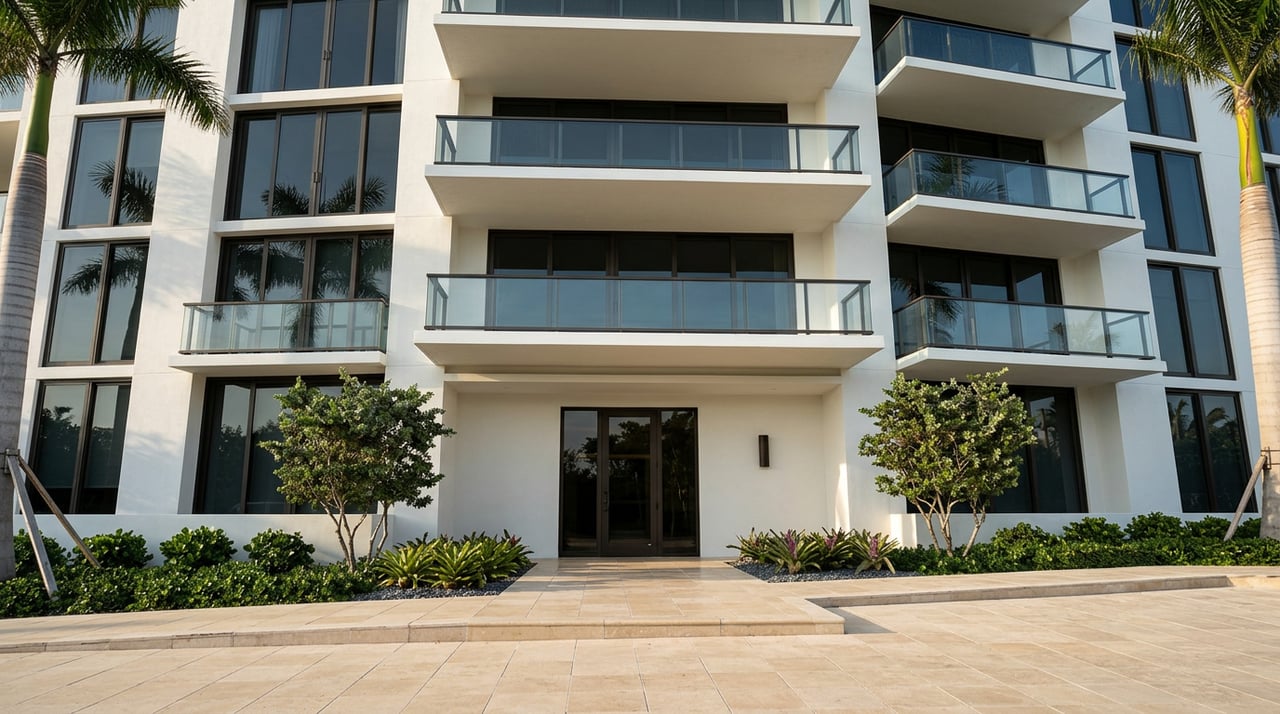
Two Park Shore condos can list at the same price per foot this fall and behave like entirely different assets at closing. One will appraise cleanly, pass a lender's condo questionnaire, and close in forty-five days. The other will sit through a second price reduction, a reserve study review, and a buyer who quietly walks after the milestone inspection comes back. The MLS shows one number. The transaction shows two.
That gap is the story of Park Shore in late 2026, and it is not what the portals are telling you.
The Median Is Doing Two Jobs at Once
As of July 18, 2026, Park Shore was carrying 142 active listings at an average of 167 days on market, an average of about $1,158 per square foot, and a median list price of $1,635,000. Redfin's condo-only cut of the same neighborhood put the median list at $1.86 million with roughly 182 units for sale. Trailing three-month data through May 2026 showed the median sale price at $2.0 million, down 14.9% year over year, on 117 recorded sales for the month versus 61 the year prior.
Read the numbers together and the picture is not "the market softened." It is "the market split." Volume roughly doubled year over year while the median fell double digits and days on market drifted past five months. That combination almost never comes from a uniform pullback. It comes from a widening spread between what sells fast and what sits, with buyers concentrating on one side of the aisle and sellers still pricing to the other.
Two things are producing that spread, and neither shows up on a portal filter.
The Filing That Quietly Sorted the Buildings
Florida's Structural Integrity Reserve Study requirement, the post-Surfside reserve-and-milestone regime often shortened to SIRS, hits its final compliance window in 2026. For condominium buildings three stories or taller past a certain age threshold, that means a completed milestone inspection and a fully funded reserve study on file, with the assessments to match.
Park Shore has 25 architecturally significant beachfront towers along Gulf Shore Boulevard, and the vast majority went up between the late 1960s and the late 1990s. The neighborhood's newest Gulf-front high-rises are Aria, delivered in 2006, and the Regent, delivered in 2002. Everything else is inside the window where SIRS matters most.
Buyers this year are sorting accordingly. Two questions decide the sort:
- Has the association completed its milestone inspection, and what did it find?
- Are reserves funded to the study, or is the funded number a fraction of the recommended number with an assessment queued behind it?
A "yes, and clean" answer produces one kind of Park Shore listing: the one that trades near ask, appraises without drama, and closes on schedule. A "not yet" or "yes, with a pending special assessment" answer produces the other kind, and it is the second kind that is dragging the neighborhood's DOM average toward six months. Same view. Same square footage. Different asset.
This is why buildings like Surfsedge continue to see quiet, off-market interest despite being originally built in the 1970s, while newer-but-uncertain stock in the mid-price band sits. The market is not paying for the year on the cornerstone. It is paying for the paper on file with the condo association.
What Q4 2026 Does to the Comp Set
Now add the second mechanism. Rosewood Residences Naples, at 1601 Gulf Shore Boulevard North just south of the Park Shore boundary, is targeted for completion in the fourth quarter of 2026. It is a 42-unit, seven-story project from The Ronto Group in partnership with Wheelock Street Capital, with interiors by MHK Architecture and Lillian Wu Studio and residential service by Rosewood Hotels & Resorts. Financing closed at $234 million through affiliates of Apollo in August 2024. The building topped off on August 1, 2025.
The numbers that matter for a Park Shore buyer are these. Residences run from 4,226 to 9,673 square feet. Asking prices are $12.75 million to $45 million, with five penthouses in that range. And, by the developer's own framing and independent broker analysis, this is the first true new-construction beachfront condominium delivered on the Naples coast since Moraya Bay was completed in North Naples in 2009. A seventeen-year gap.
That gap matters because appraisers work from recent sales of comparable properties. For almost two decades, the top of the Gulf-front comp set in and around Park Shore has been dominated by resales in buildings whose newest members, Aria and Regent, are already twenty and twenty-four years old. When Rosewood begins closing units, the ceiling of the beachfront comp grid resets, and it resets on inventory built to the current code, with current impact glazing, current reserve structure, and current amenity expectations.
Here is where the two mechanisms combine. The buildings inside Park Shore that finish 2026 with clean milestone paper and funded reserves will draft off the Rosewood benchmark, because they are the ones an appraiser can credibly bracket underneath it. The buildings that finish 2026 with open questions will not. They will get compared instead to the softer end of the resale set, and the spread that already exists in the mid-2026 data will widen, not narrow.
A Rough Timeline of the Beachfront Stack
| Era | Representative Park Shore towers | What a buyer should ask first |
|---|---|---|
| 1970s | Surfsedge, La Mer, Provence-area predecessors | Milestone inspection status and any 40-year recertification history |
| 1980s to mid-1990s | Le Parc, Gulfside, Vistas, Park Plaza, Brittany | Reserve study funding level versus recommended, any special assessment on the horizon |
| Early 2000s | Regent (2002), Aria (2006), Le Ciel Venetian Tower | Insurance carrier stability and recent premium history |
| Late 2026 delivery | Rosewood Residences Naples, north edge of Old Naples | Not a Park Shore address, but the new ceiling of the beachfront comp set |
The table is not a ranking. It is a reminder that the right first question changes with the era, and that "what year was it built" is a weaker filter in 2026 than "what does the reserve study say."
What to Actually Ask on a Showing This Fall
If you are touring Park Shore towers between now and January, the useful questions have shifted. In roughly the order they matter:
- Show me the most recent reserve study and the current funded percentage.
- Show me the milestone inspection report and any recommended repairs, with dates.
- What was the last special assessment, and is there one contemplated inside the next twenty-four months?
- Who is the current insurance carrier, what is the master policy premium trend over the last three renewals, and is wind coverage inside the master or separately placed?
- What are the current pet, lease, and guest-occupancy rules, and have they changed in the last twelve months?
None of that is available on a listing sheet. All of it moves the closing price in a real transaction.
The Transaction Friction Nobody Warns You About
Two frictions are specific to Park Shore in the current window.
The first is condo questionnaire timing. Lenders on Gulf-front condos are asking for more from the association than they were even eighteen months ago, and associations under SIRS review are often triaging their own board work over lender paperwork. Build an extra two to three weeks into your financing contingency if the association is still in its inspection cycle. Cash buyers have a real, measurable advantage in this specific inventory this specific fall, and it is not because sellers dislike financing. It is because timing risk is priced into the counter.
The second is Gulf access. Park Shore boaters reach open water through Doctors Pass, at the neighborhood's southern boundary in The Moorings. Dredge cycles at that pass and slip availability at Park Shore Marina or the Venetian Bay Yacht Club affect which bayfront and canal-front units trade at a premium in any given quarter. If a unit's value proposition rests on a deeded slip, verify the slip separately from the unit, including the current dockage agreement and any pending seawall or dredge assessment.
Neither friction shows up in a portal median. Both show up in the closing statement.
FAQ
Is Rosewood Residences Naples technically in Park Shore? No. Its 1601 Gulf Shore Boulevard North address sits just south of the Park Shore boundary, closer to Lowdermilk Park and the north edge of Old Naples. It is relevant to Park Shore anyway because appraisers work off the beachfront comp grid, not off subdivision plats.
Does the softer May 2026 median mean prices are still falling? It means the mix of what sold got heavier on smaller and older units and lighter on trophy Gulf-front stock. In a split market, a moving median is a mix signal more than a price signal. Look at price per foot inside a specific building over the trailing twelve months before drawing a conclusion.
Why do buildings from the 1970s still trade well when newer inventory sits? Because reserve clarity and unit scarcity are, in 2026, worth more to the market than a younger cornerstone. A well-run older building with a clean milestone inspection and low turnover is a known quantity. A less-run building of any age is not.
If you are working through a specific Park Shore tower and want the reserve study, milestone status, and comparable-sale read before you write an offer, or you are on the sell side and want to understand where your building sits inside the sort described above, let's have that conversation. Reach out to Michael Moreiras and we will start with the paper on file and work forward from there. Let's Connect.